Zhiyun’s M20c was announced in November 2023, and after six months it is still the most powerful camera-mountable RGB LED light with special effects and light modifiers, which is no small feat for Zhiyun, a company more traditionally known for gimbals. The fact that the M20c also comes with a diffuser, barn doors, a grid, and a removable cage that has three built-in cold shoe mounts for additional accessories makes it appealing as an upgrade or supplement as all other lights with this feature set are significantly smaller as not as bright, such as Aputure’s significantly smaller and lower wattage MCs.
Concept
Zhiyun’s marketing of the M20c suggests that its power (20 watts) and size (of a sticky note) are enough for many run-and-gun creators. Its accuracy and scalability should appeal to studios and larger productions. So is it a jack of all trades or a master of none? There’s only one way to find out.
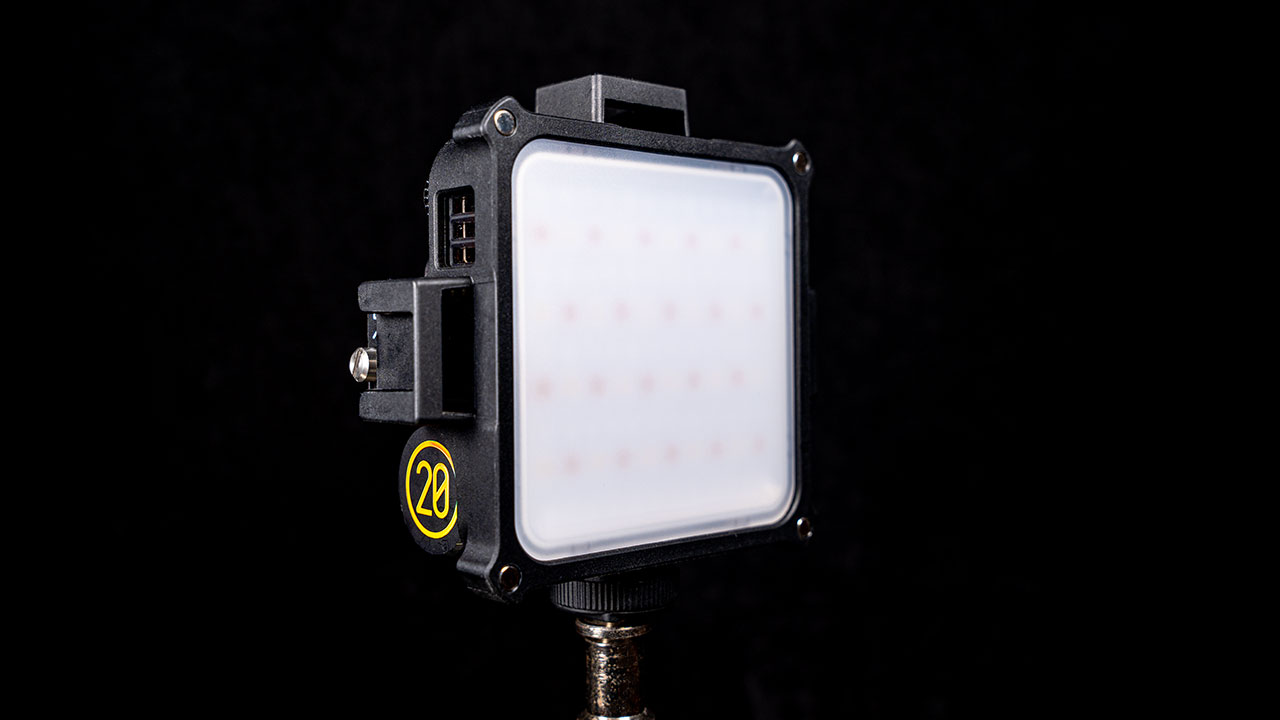
The small M20c with its cage
Build and Design
The M20c’s design involves a deliberate trade-off where resistance to water and dust is sacrificed in favor of heat dissipation. How else could such a powerful light be made so small? Peering inside reveals the first of multiple hot sinks, which work with a fan to provide heat dissipation and responsive cooling. Indeed, during the battery life test at 100%, it didn’t overheat once. That said, the fan became louder and maybe a bit too loud at this highest power setting for some users who need to have a microphone within a few feet of the light, but we think there is still potential for professional-looking video in this scenario at 50% power or lower where the fan isn’t as loud or isn’t needed at all; however, in a vlog setup with the light mounted to the camera at 100% power, the fan will be heard on a built-in camera mic.
A hard plastic cage with three cold shoe mounts gives this light much-needed protection, much like the way a good phone case does, by placing elevated ridges around the screen, or in this case the LED portion of the light, and protecting it from a face-down fall onto a flat surface. The three cold shoe mounts make it a reasonable proposition to combine multiple M20cs, other small LEDs, or a microphone, but going much further than that could be risky since the main attachment point of the light is a plastic-metal cold shoe or its built-in 1/4″-20 female thread. The magnets on the back of the light are probably the best solution for a stacking scenario as these are reliably strong.
The magnets for the attachments on the front are not as strong as the ones on the back, but that would be unnecessary. Although the barn doors slipped off at least once, every time I used the light, their metallic feel struck me as I was able to endure many more drops. Furthermore, if those magnets were any stronger, the various modifiers would be difficult to put and take off with one hand, which I found myself doing. The other modifiers include a flat diffusion panel and a grid. So far, I’ve found all but the grid to be indispensable.
Would you believe that this is an actual image?

Controls
Zhiyun offers a free smartphone app called ZY Vega for controlling one or more lights through Bluetooth. As far as I can tell, it’s identical in function to the Sidus app by Aputure, and that’s a good thing. The settings are controlled using two twist knob buttons on the top rear of the light in conjunction with a 2cm by 1 cm LCD screen located smack in between those knobs. This is where I found something that could make this light even more user-friendly. If the prioritizing of air vents and hot-shoes cramped design options for button layout, it would be worth making the reduced number of available buttons as capable as possible to offset that. It’s good that they aren’t smaller. Instead of more, smaller buttons, the current ones could have more recognizable stops so that at least some functions can be reached without having to look at the screen.
The two controls and screen on the back of the Zhiyun-M20c

Test Results
As always we ran the light through our normal set of tests using the Sekoni C800 spectrometer at two distances and you can see the full results below:
Results for the M20c at 3200K @1m 100% (no diffusion):
- Color temperature: 3288K.
- Output: 285 Lux.
- CRI: 96.8 (R9 – 93.4; R12 – 89.6).
- TLCI: 99.
- TM-30 RF: 96; TM-30 Rg – 103.
- SSI: 84.


Results for the M20c at 5600K @1m 100% (no diffusion):
- Color temperature: 5554K.
- Output: 557 Lux.
- CRI: 96.2 (R9 – 86.1; R12 – 84.9).
- TLCI: 99.
- TM-30 RF: 95; TM-30 Rg – 103.
- SSI: 75.


Results for the M20c at 3200K @30cm 100% (no diffusion):
- Color temperature: 3218K.
- Output: 5210 Lux.
- CRI: 97 (R9 – 96; R12 – 89.6).
- TLCI: 99.
- TM-30 RF: 96; TM-30 Rg – 103.
- SSI: 85.


Results for the M20c at 5600K @30cm 100% (no diffusion):
- Color temperature: 5579K.
- Output: 5780 Lux.
- CRI: 96 (R9 – 85.4; R12 – 84.7).
- TLCI: 99.
- TM-30 RF: 94; TM-30 Rg – 102.
- SSI: 75.


Results for the M20c at 5600K @1m 100% (with diffusion):
- Color temperature: 5556K.
- Output: 344 Lux.
- CRI: 95.4 (R9 – 66.9; R12 – 85.4).
- TLCI: 99.
- TM-30 RF: 94; TM-30 Rg – 103.
- SSI: 75.


Results for the M20c at 5600K @30cm 100% (with diffusion):
- Color temperature: 5583K.
- Output: 3630 Lux.
- CRI: 95.4 (R9 – 67.1; R12 – 85.2).
- TLCI: 99.
- TM-30 RF: 94; TM-30 Rg – 103.
- SSI: 75.


One interesting note that we briefly mentioned in the video, we discovered that by putting on the diffuser first, then the grid will retain the most brightness. Having the grid in first then the diffuser resulted in a drastic drop in brightness so be aware of that.
Use Cases
The M20c can function in the studio as a key light (or any other traditional lighting component) for a small product or a relatively small portrait such as a single or double headshot. Larger diffusion is needed to handle bigger subjects, but we may try that. Outdoors, the light is less relevant, though it might sometimes capture video in the shade and help creators prevent blown-out backgrounds.
The visual effects were a mixed bag due to the difficulty in programming natural randomness or a pattern complex and long enough to fake it. The candle, bad bulb, TV, and lightning effects suffer from this, but the paparazzi, explosion, welding, and firework programs do a better job. CCT and HSI both loop, flash, and pulse to round out the capabilities, and there’s even an SOS function if you are ever lost in the wilderness and need to signal a helicopter.
Using the Zhiyun-M20c as a selfie light

Pricing
The Zhiyun M20c is selling for $160 on Amazon at the time of this article’s publishing.
You can check out more LensVid exclusive articles and reviews on the following link.



You can support LensVid by shopping with our affiliate partners
Affiliates: Amazon, B&H, Adorama and E-bay.
Why should you trust us?
Hi, This is a very Impressive and also very informative post.
Glad you liked it – more to come soon!